Plain Black And White Photographs and Images Headline Animator

Plain Black And White Photographs and Images
Showing posts with label Birds around home. Show all posts

Tuesday, May 10, 2011

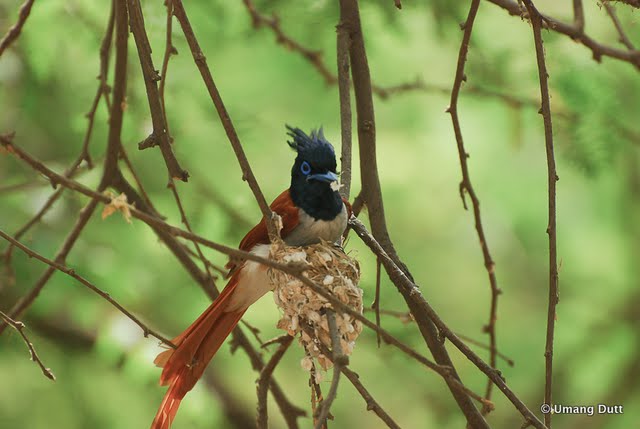
Asian Paradise-flycatcher (Terpsiphone paradisi)

The Asian Paradise-flycatcher (Terpsiphone paradisi), also known as the Common Paradise-flycatcher, is a medium-sized passerine bird native to Asia.

Adult Asian Paradise-flycatchers are 19–22 cm long. Their heads are glossy black with a black crown and crest, their black bill round and sturdy, their eyes black. Female are rufous on the back with a greyish throat and underparts. Their wings are 86–92 mm long. Male Asian Paradise-flycatchers change the colour of their plumage in the first few years of their lives. Sub-adult males look very much like females but have a black throat and blue-ringed eyes. As adult they develop up to 24 cm long tail feathers. Their rufous plumage moults into white with the central pair of tail feathers growing up to 30 cm long streamers that droop. There are adults called rufous-morph with rufous wings and tail but white underparts.

Asian Paradise-flycatcher (Terpsiphone paradisi)

Asian Paradise-flycatcher (Terpsiphone paradisi)

Asian Paradise-flycatcher (Terpsiphone paradisi)

Asian Paradise-flycatcher (Terpsiphone paradisi)

Asian Paradise-flycatcher (Terpsiphone paradisi)

Asian Paradise-flycatcher (Terpsiphone paradisi)

Saturday, July 26, 2008

White-throated Kingfisher, Halcyon smyrnensis

Cute . . .I waited a looong time for the 2nd one to come... finally i got lucky

The White-throated Kingfisher, Halcyon smyrnensis, also known as the White-breasted Kingfisher or Smyrna Kingfisher, is a tree kingfisher which is widely distributed in south Asia from Turkey east to the Philippines. This kingfisher is essentially resident over much of its range, apart from seasonal movements.
The first of the alternative English names is to be preferred because the geographical name is too restrictive for this widespread bird, and the easternmost race lacks a white breast.

This is a large kingfisher, 28 cm in length. The adult has a bright blue back, wings and tail. Its head, shoulders, flanks and lower belly are chestnut, and the throat and breast are white.

There are four races differing mainly in plumage shades, but H. s. gularis of the Philippines has only the neck and throat white. The flight of the White-throated Kingfisher is rapid and direct, the short rounded wings whirring. The large bill and legs are bright red.

In flight, large white patches are visible on the blue and black wings. Sexes are similar, but juveniles are a duller version of the adult. The call of this noisy kingfisher is a chuckling chake-ake-ake-ake-ake.

White-throated Kingfisher is a common species of a variety of habitats with some trees, and its range is expanding. It perches conspicuously on wires or other exposed perches within its territory, and is a frequent sight in south Asia. This species mainly hunts large insects, rodents, snakes, fish and frogs. It is reputed to eat tired migratory passerine birds like Chiffchaffs where the opportunity arises.

White-throated Kingfisher has a striking display in which the wings are spread to show the white patches. The nest is a 50cm tunnel in an earth bank. A single clutch of 4-7 round white eggs is typical

Monday, July 14, 2008

Love the background in this one


Jungle babbler (Turdoides striata)

The Jungle Babbler, Turdoides striata, is an Old World babbler. The Old World babblers are a large family of Old World passerine birds characterised by soft fluffy plumage. These are birds of tropical areas, with the greatest variety in southeast Asia.
The Jungle Babbler is a resident breeding bird in India and Pakistan. In the past, the Orange-billed Babbler, Turdoides rufescens, of Sri Lanka was considered to be a race of this babbler, but is now normally given full species status.

The Jungle Babbler's habitat is forest and cultivation. This species, like most babblers, is not migratory, and has short rounded wings and a weak flight.

It is quite common in Indian forests It builds its nest in a tree, concealed in dense masses of foliage. The normal clutch is two to six deep greenish blue eggs.

These birds are grey brown below, with some mottling on the throat and breast. The upperparts are a slightly darker shade. The head is grey, and the bill is yellow. The race T. s. somervillei of Maharastra has an orange tail and dark primary flight feathers.

The Jungle Babbler lives in flocks of seven to ten or more. It is a noisy bird, and the presence of a flock may generally be known at some distance by the harsh mewing calls, continual chattering, squeaking and chirping produced by its members. It feeds mainly on insects, but also eats nectar and berries.

Tuesday, April 1, 2008

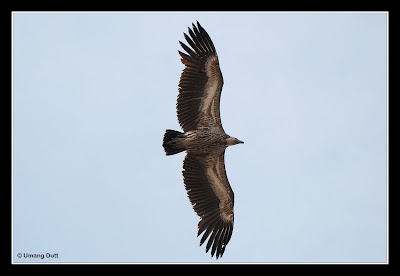
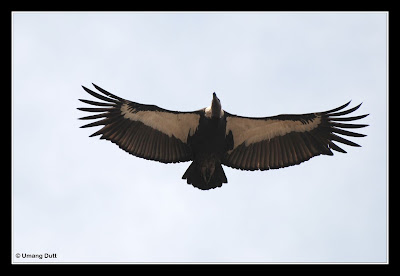
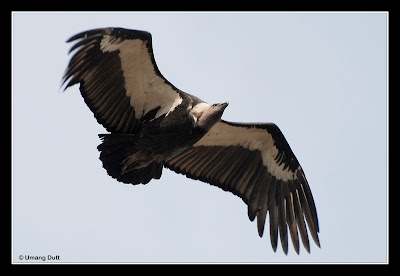
Indian White-rumped Vulture (Gyps bengalensis)

The Indian White-rumped Vulture (Gyps bengalensis) is an Old World vulture in the family Accipitridae, which also includes eagles, kites, buzzards and hawks. It is closely related to the European Griffon Vulture (Gyps fulvus) though less so than it was long believed to the White-backed Vulture. Its alternate name, Oriental White-backed Vulture, is a leftover from that time.

It breeds on crags or in trees in northern and central India, Pakistan and southeast Asia, laying one egg. Birds may form loose colonies. The population is mostly resident.

Like other vultures it is a scavenger, feeding mostly from carcasses of dead animals which it finds by soaring over savannah and around human habitation. It often moves in flocks.

The White-rumped Vulture is a typical vulture, with a bald head, very broad wings and short tail. It is much smaller than European Griffon. It has a white neck ruff. The adult’s whitish back, rump and underwing coverts contrast with the otherwise dark plumage. Juveniles are largely dark.

Conservation status - CRITICALLY ENDANGERED


Conservation status - CRITICALLY ENDANGERED


Conservation status - CRITICALLY ENDANGERED


This is the smallest of the Gyps vultures, with 75-85 cm in length, and 4.75 kg in weight.


Sunday, March 30, 2008

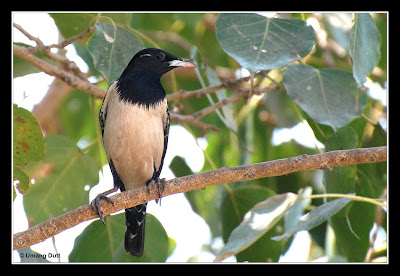
Rosy starling (Sturnus roseus )

The Rosy Starling, or Rose-coloured Starling, Sturnus roseus is a passerine bird in the starling family Sturnidae. It is sometimes given its own, monotypic genus Pastor; a split supported by recent studies; its closest living relatives are still not certainly known


The breeding range of this bird is from easternmost Europe across temperate southern Asia. It is a strong migrant, and winters in India and tropical Asia. In India in winter, it often appears to outnumber the local starlings and mynas. The adult of this species is highly distinctive, with its pink body, pale orange legs and bill, and glossy black head, wings and tail. Males in the breeding season have elongated head feathers which form a wispy crest that is fluffed and more prominent when the bird gets excited; the crest is shorter in winter and the black areas have paler feather edges, which get worn away as well as the black becoming more glossy in the breeding season. Winter plumage in males is rather dull

Females have a short crest and are duller overall, especially without the sharp separation betwenn pink and black. The juvenile can be distinguished from Common Starling, Sturnus vulgarus by its obviously paler plumage and short yellow bill. Young birds molt into a subdued version of the adult plumage, lacking the crest, in autumn and acquire the adult plumage when they are nearly one year old in females, and nearly two years in males. The latter in their second year wear a plumage similar to adult females but with longer crests and nmoticeably pale feather edges.

This is a colonial breeder, and like other starlings, is highly gregarious, forming large winter flocks. It also shares the other species' omnivorous diet, although with a preference for insects.

The song is a typical starling mixture of squeaks and rattles, given with much wing trembling

Barbet Mania

Some more pics of my favourite bird.. check out the whiskers on this one


patterns on the back of the barbet ...

Thursday, March 13, 2008

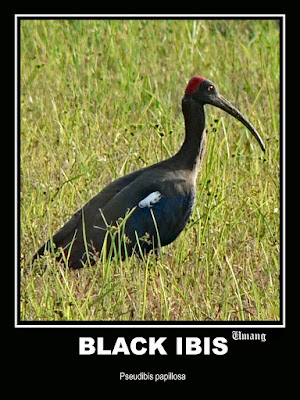
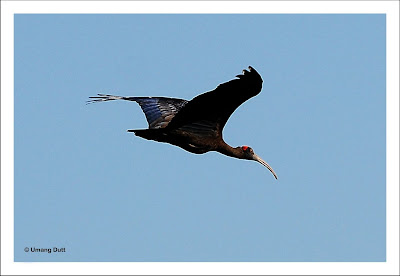
Black Ibis, Pseudibis papillosa

This is one of the older pictures I took with my Lumix-FZ5

The black Ibis is a nice little bird, the red head makes it stand out and look a lot more attractive than it is :)


Black Ibis in flight


The Black Ibis, Pseudibis papillosa is a species of ibis found in parts of south Asia. It is often found in dry land is not as aquatic as many other species of ibis.Black Ibis (Pseudibis papillosa), also known as Red-naped Ibis, is a common breeding resident in Haryana. Sexes alike, this largish black bird is found at lakes, marshes, riverbeds and irrigated farmland. It has a curlew-like long down-curved bill, black head with a patch of crimson and white patch near the shoulder. It generally forages on margins of wetlands in small numbers, is gregarious, nests on trees, and breeds from March to October in North India

Wednesday, March 12, 2008

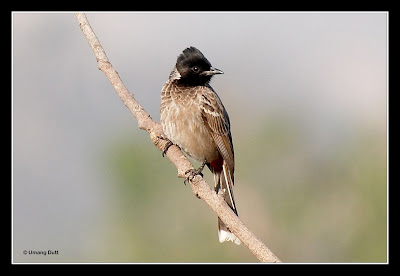
White-eared Bulbul, Pycnonotus leucotis

This species is very similar in appearance to the Himalayan White-cheeked Bulbul Pycnonotus leucogenys but smaller and uncrested and with a larger white cheek patch. It has a pale bare eye-ring. The vent is orange yellow. Sexes are alike.


Solitary bulbul...


It is found in scrub forest and gardenland. Also found in flocks or pairs in the magroves, gorging on the fruits of the Meswak bush. Usually seen in pairs or small groups. It feeds on fruits and insects, and breeds in March-June.

Monday, March 10, 2008

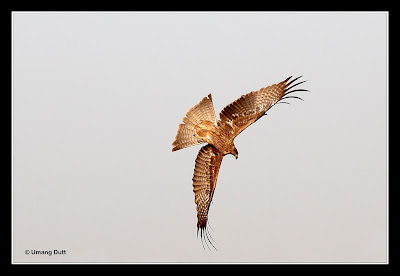
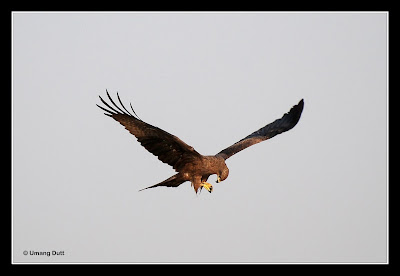
Black Kite, Milvus migrans

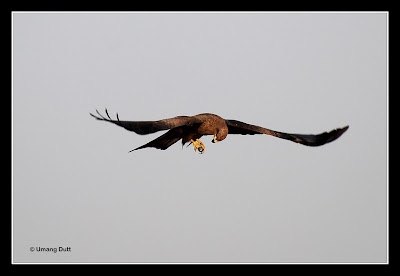
The Black Kite (Milvus migrans) is a medium-sized bird of prey in the family Accipitridae which also includes many other diurnal raptors such as eagles, buzzards, and harriers.

The pictures here are of the Milvus migrans govinda(sub-species)or the Pariah Kite

Black Kites will take small live prey as well as fish, household refuse and carrion. They are attracted to fires and smoke where they seek escaping insect prey. They are well adapted to living in cities and are found even in densely populated areas. Large numbers may be seen soaring in thermals over cities.

Poised to strike


Gottcha ...


Or did I ?? (checking to see if it was on target)


Oops looks like I missed this one ...


In some places they will readily swoop to take to food offered by humans, their habit of swooping to pick up dead rodents from roads often leads to them being hit by vehicles. They are also a major nuisance at some airports where they are considered important birdstrike hazards.

Sunday, March 9, 2008

Cattle Egret, Bubulcus ibis

The Cattle Egret (Bubulcus ibis) is a small white heron. It is the only member of the monotypic genus Bubulcus.


Glassy eyed ... Loved the angle of this pic and how it was framed against the blue sky... See the yellow feathres on the head.. thats the breeding plumage


Description
The Cattle Egret is a stocky species, averaging 51 cm long and weighing 200-600 g, with a short thick bill. The non-breeding adult has all-white plumage, a yellow bill, and greyish-yellow legs. When breeding, orange buff plumes develop on the back, breast and crown, and the legs become orange pink. The sexes are similar, but juvenile birds have a black bill.

This bird will give soft kre calls in flight, and a gruff rick-reck on the ground.

Habitat
The Cattle Egret is often found in dry grassy habitats, unlike most herons which are associated with shallow water. It feeds on insects, especially grasshoppers, and is usually found with cattle and other large animals which disturb small creatures which the egrets then catch. This species will sometimes ride on the backs of these animals.

Distribution
The Cattle Egret is native to parts of Asia, Africa and Europe.

Most Cattle Egrets are permanent residents with some post-breeding dispersal, which may have led to the egret's range expansion.

Reproduction
The breeding habitat of the Cattle Egret is large wetlands in warm countries. It nests in colonies, often with other wading birds, usually on a platform of sticks in trees or shrubs, laying one to five eggs. It may reproduce in rural and urban locations, provided there is a suitable pond or pool available.

Saturday, March 8, 2008

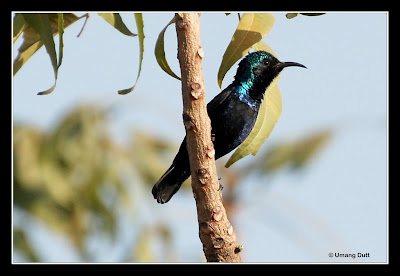
Purple Sunbird, Cinnyris asiaticus

Sunbirds are amongst my favourite birds. Small, cute and very vibrant. They never seem to sit still and so its great fun trying to photograph them.

The Purple Sunbird, Cinnyris asiaticus, is a sunbird. The sunbirds are a group of very small Old World passerine birds which feed largely on nectar, although they will also take insects, especially when feeding young. Flight is fast and direct on their short wings. Most species can take nectar by hovering like a hummingbird, but usually perch to feed most of the time.
Purple Sunbird is an abundant resident breeder across tropical southern Asia from the Persian Gulf to Southeast Asia. One to three eggs are laid in a suspended nest in a tree.
Purple Sunbirds are tiny, only 10cm long. They have medium-length thin down-curved bills and brush-tipped tubular tongues, both adaptations to their nectar feeding.

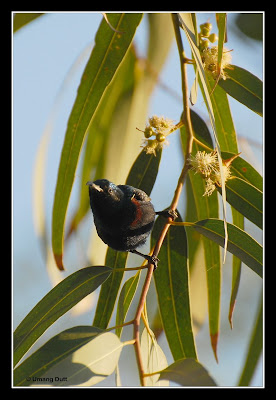
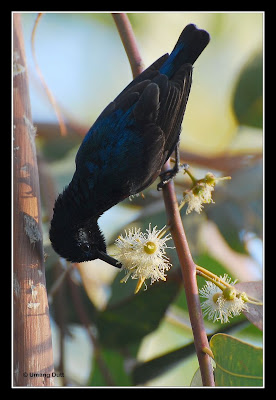
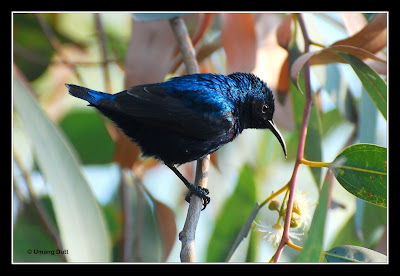
These are some of best pics of the purple sunbird...
Adult males in breeding plumage


The adult male is mainly glossy purple. The eclipse male has a yellow-grey upperparts and a yellow breast with a blue central streak extending to the belly. The female has yellow-grey upperparts and yellowish under parts, and a faint supercilium. The call is a humming zit zit.

This species is found in a variety of habitats with some trees, including forest and cultivation.

Friday, March 7, 2008

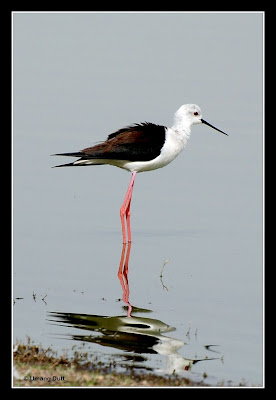
Black winged stilt, Himantopus himantopus

The Black-winged Stilt, Himantopus himantopus, is a large wader in the avocet and stilt family, Recurvirostridae.

Adults are 33-36 cm long. They have long pink legs, a long thin black bill and are mainly white with a dark cap and a dark back.

Stilt in solitary Splendor


Amazing synchronization


Its a really beautiful site to see these stilts skimming across the water


The breeding habitat of all forms is marshes, shallow lakes and ponds. The nest site is a bare spot on the ground near water. These birds often nest in small groups, sometimes with avocets.

Some populations are migratory and move to the ocean coasts in winter.

These birds pick up their food from sand or water. They mainly eat insects and crustaceans.

Thursday, March 6, 2008

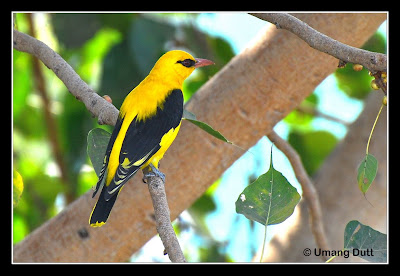
Golden Oriole, Oriolus oriolus

The Golden Oriole or European (or Eurasian) Golden Oriole Oriolus oriolus, is the only member of the oriole family of passerine birds to breed in northern hemisphere temperate regions. It is a summer migrant to Europe and western Asia, wintering in the tropics.

The male is striking in the typical oriole black and yellow plumage, but the female is a drabber green bird. Orioles are shy, and even the male is remarkably difficult to see in the dappled yellow and green leaves of the canopy.

This fellow is a regular, to my compound...


Just so that you can decide which profile you like better :)


The flight is somewhat like a thrush, strong and direct with some shallow dips over longer distances.

The call is a screech like a jay, but the song is a beautiful fluting weela-wee-ooo or or-iii-ole, unmistakable once heard.

The neat nest is built in a fork in a tree, and contains 3-6 eggs. The food is insects and fruit, found in the tree canopies where the orioles spend much of their time.

Wednesday, March 5, 2008

Shyness - Indian Peafowl, Pavo Cristatus

“Many a man is praised for his reserve and so-called shyness when he is simply too proud to risk making a fool of himself.”

An unusual pic of of an Indian Peafowl (Pavo cristatus) . Unususal because of the black background, which makes this pic stand out from the 'other' preening pics.

The term peafowl can refer to the two species of bird in the genus Pavo of the pheasant family, Phasianidae. Peafowl are best known for the male's extravagant tail, which it displays as part of courtship. The male is called a peacock, the female a peahen, though it is common to hear the female also referred to as a "peacock" or "female peacock". The female peafowl is brown or toned grey and brown.

Many of the brilliant colours of the peacock plumage are due to an optical interference phenomenon (Bragg reflection) based on (nearly) periodic nanostructures found in the barbules (fiber-like components) of the feathers.

Tuesday, March 4, 2008

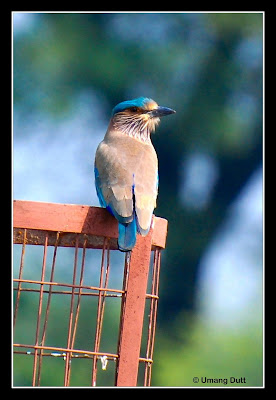
Indian Roller, Coracias benghalensis

The Indian Roller is without doubt one of the most amazing birds I have ever seen.

The Indian Roller (Coracias benghalensis), was formerly locally called the Blue Jay. It is a member of the roller family of birds which breeds in tropical southern Asia from Iraq to Thailand. It is not migratory, but undertakes some seasonal movements.

It looks quite ordinary when viewed from behind...


Upfront its a cute little bird with a a sprinkling of brown to go with its blue feathers


The Indian Roller is a stocky bird, the size of a Jackdaw at 30-34cm. It has a warm brown back, lilac breast and face, and blue crown, wings, tail and belly. Sexes are similar, but the juvenile is a drabber version of the adult. The Southeast Asian race C. b. affinis has a green back and purple underparts, and is sometimes considered a separate species.

From behind and in flight is the best view .. Here is a WOW shot of an Indian Roller about to land,with its wings spread in all its glory.


Indian Roller is striking in its strong direct flight, with the brilliant blues of the wings contrasting with the brown back.

Sunday, March 2, 2008

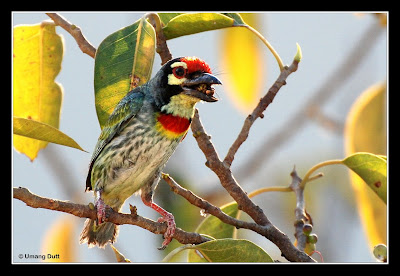
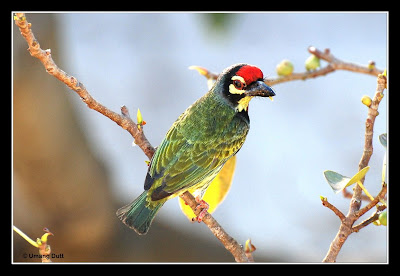
Crimson-breasted Barbet, Megalaima haemacephala

The Coppersmith Barbet or Crimson-breasted Barbet (Megalaima haemacephala), is a bird with crimson forehead and neck. It is a resident near passerine bird from South Asia, with occasional presence in Southeast Asia. The name barbet refers to the bristles or barbs fringing its heavy bill. It may sometimes be referred to simply as Coppersmith.

Barbet on top of the neem tree in my compound. I usually find a lot of them in the mornings and evenings
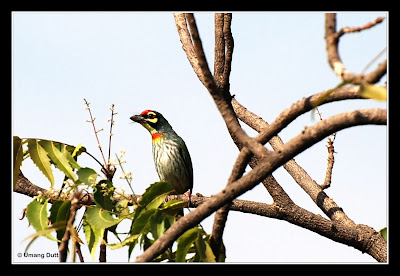

Looks like this one found something to eat, most likely a fruit from the peepal (peepul) tree


Some people may find the composition very odd, but I kind of liked he way the picture turned out...


The Coppersmith is brightly coloured, with a black-bordered yellow face with black eye stripes, red forecrown and throat patch. Bill stout and dark. Upper parts are grass green and underparts yellowish-green, diffusely streaked with darker green. Juveniles are duller and lack the red patches. The sexes are alike.

Somewhat larger than a sparrow, it is a relatively small barbet at 17 cm. It is a plump bird, with a short neck and large head. The short, truncated tail is distinctively triangular in flight

Keeps solitary, pairs, or small groups; larger parties occasionally on abundantly fruiting Ficus trees. Fond of sunning themselves in the morning on bare top branches of tall trees, often flitting about to sit next to each other. The flight is straight, with rapid flaps.

Vocalization
The call is a loud rather metallic tuk…tuk…tuk (or tunk), reminiscent of a copper sheet being beaten, giving the bird its name. Repeated monotonously for long periods, starting with a subdued tuk and building up to an even volume and tempo, the latter varying from 1.5 to 2 per second.

The beak remains shut during each call - a patch of bare skin on both sides of the throat inflates and collapses with each tuk like a rubber bulb, with much body and tail shaking. Not very vocal in cold weather - a spell of rain or cold immediately silences them, but it is "one of India's most familiar sounds in the hot season"

Prefers Banyan, Peepul, and other wild figs, various drupes and berries, and the occasional insect, caught in clumsy aerial sorties

Saturday, March 1, 2008

The Little Green Bee-eater, Merops orientalis

Well there are bee eaters and there are BEE eaters.

This one was having a really bad 'BAD HAIR DAY'


The Little Green Bee-eater, Merops orientalis, is a near passerine bird in the bee-eater family Meropidae. It is resident in a belt across sub-Saharan Africa from Senegal and The Gambia to Ethiopia, the Nile valley, western Arabia and Asia through India to Vietnam

Finally managed to get a bee eater eating a bee !! Mighty please with this one ;)

Picture of the bee eater showing me the prized catch


Holding the trophy aloft before it went straight down its throat


Like other bee-eaters, this species is a richly coloured, slender bird. It always has green upper parts, but the head and underpart colours vary widely depending on the subspecies. Thus, southeast Asian birds have rufous crown and face, and green underparts, whereas Arabian breeders have a green crown, blue face and bluish underparts. The wings are green and the beak is black. It reaches a length of 16-18 cm, including the two elongated central tail feathers. These elongated tail feathers are absent in juveniles.